Rogha Research
Who supplies China’s factories? Two robotics ETFs compared
China installed 59% of the world’s new industrial robots in 2025. Who supplied those robots? Chinese manufacturers supplied 55% of the machines that went into Chinese factories. Foreign suppliers accounted for about 45%. Which suppliers does a global robotics ETF already hold, and which companies would a China-focused ETF add?
The iShares Automation & Robotics UCITS ETF (2B76) owns Japan’s FANUC, which won a contract to supply robots to a Volvo Cars plant in China. The HSBC MSCI China Robotics UCITS ETF (BOTS) takes a different route. Its largest holding makes the precision gears that move robot joints. Eight of HSBC’s ten largest companies were absent from iShares. Together they accounted for about €390 of every €1,000 in BOTS.
Who supplies the factory floor?
Chinese factories installed about 354,000 industrial robots in 2025. Chinese manufacturers supplied about 195,000, up 15% on the previous year. Even so, their domestic share slipped from 57% to 55% as the overall market grew faster. Foreign manufacturers supplied roughly 159,000 units. That leaves a substantial market for overseas companies even as local manufacturers expand.
International Federation of Robotics, World Robotics 2026 · New industrial robot installations in 2025.
FANUC supplies the finished robot. Its agreement with Volvo Cars named Daqing in China alongside plants in Belgium and Slovakia. FANUC was 1.95% of iShares on 17 November, about €19.52 per €1,000. BlackRock assigns FANUC to Japan. Looking only at the four iShares equities BlackRock assigns to China, together 0.26% of the fund, would miss this supplier altogether. The €19.52 measures the stake in FANUC. The contract announcement does not disclose how much revenue Daqing generates for the company.
FANUC’s Volvo Cars contract · BlackRock fund holdings, 17 November 2026.
Leaderdrive supplies a part. Leader Harmonious Drive Systems, 6.22% of HSBC, makes precision gearing used in robot joints. A component maker can earn money from the robot manufacturer before a factory takes delivery. Further along the chain, UBTECH reported practical work with its Walker S1 humanoid at Geely’s Zeekr plant in Ningbo. That is evidence of a factory trial. The report does not quantify repeat orders from that plant.
Leaderdrive company profile · UBTECH 2024 annual report.
What €1,000 in BOTS adds
We compared HSBC’s ten largest holdings with all 159 equity positions in iShares at October month-end. Only Shanghai Baosight Software and UBTECH appeared in both. We repeated the check against iShares’ November portfolio and found the same two names.
Inside €1,000 of BOTS
Of that €1,000 in BOTS, €60.60 was in Baosight and €41.60 in UBTECH. The same €1,000 in 2B76 at October month-end held about €0.28 and €1.44 respectively. The €390.20 is a minimum because the exchange disclosed only HSBC’s ten largest positions.
What sits at the top?
HSBC’s ten largest holdings accounted for 49.24% of its portfolio on 31 October, compared with 33.04% for the iShares top ten on 17 November. HSBC reported 35 holdings excluding cash. The iShares top ten included enterprise software company SAP and surgical robotics company Intuitive Surgical. HSBC also reaches beyond the factory floor. Horizon Robotics, its seventh-largest holding, develops assisted-driving technology for vehicles.
| Company | Weight |
|---|---|
| Leader Harmonious Drive Systems | 6.22% |
| Shanghai Baosight Software | 6.06% |
| Lingyi iTech (Guangdong) | 5.71% |
| Shenzhen Zhaowei Machinery & Electronics | 5.00% |
| Hesai Group | 4.57% |
| Guangzhou Haozhi Industrial | 4.42% |
| Horizon Robotics | 4.42% |
| Bozhon Precision Industry Technology | 4.36% |
| Infore Environment Technology Group | 4.32% |
| UBTECH Robotics | 4.16% |
| Company | Weight |
|---|---|
| SAP | 3.91% |
| Snowflake | 3.59% |
| Emerson Electric | 3.52% |
| Advanced Micro Devices | 3.34% |
| Autodesk | 3.26% |
| Intuitive Surgical | 3.18% |
| Advantest | 3.13% |
| Keyence | 3.08% |
| Siemens | 3.05% |
| Constellation Software | 2.97% |
Fund weights, ordered by size. HSBC top ten via the London Stock Exchange · iShares holdings via BlackRock · Horizon Robotics investor information.
How do the charges and risk scores compare?
On a constant €1,000 holding, the annual fund charge works out at about €4 for iShares and €5 for HSBC. Each fund’s EU Key Information Document gives it a risk score of 5 out of 7. Those individual scores tell us little about how the two funds would move together.
Two robotics ETFs compared
| ETF | Annual TER | EU risk score |
|---|---|---|
| iShares Automation & Robotics | 0.40% | 5 / 7 |
| HSBC MSCI China Robotics | 0.50% | 5 / 7 |
Rogha Research comparison using BlackRock, the London Stock Exchange and both issuers’ EU Key Information Documents. Checked 19 November 2026.
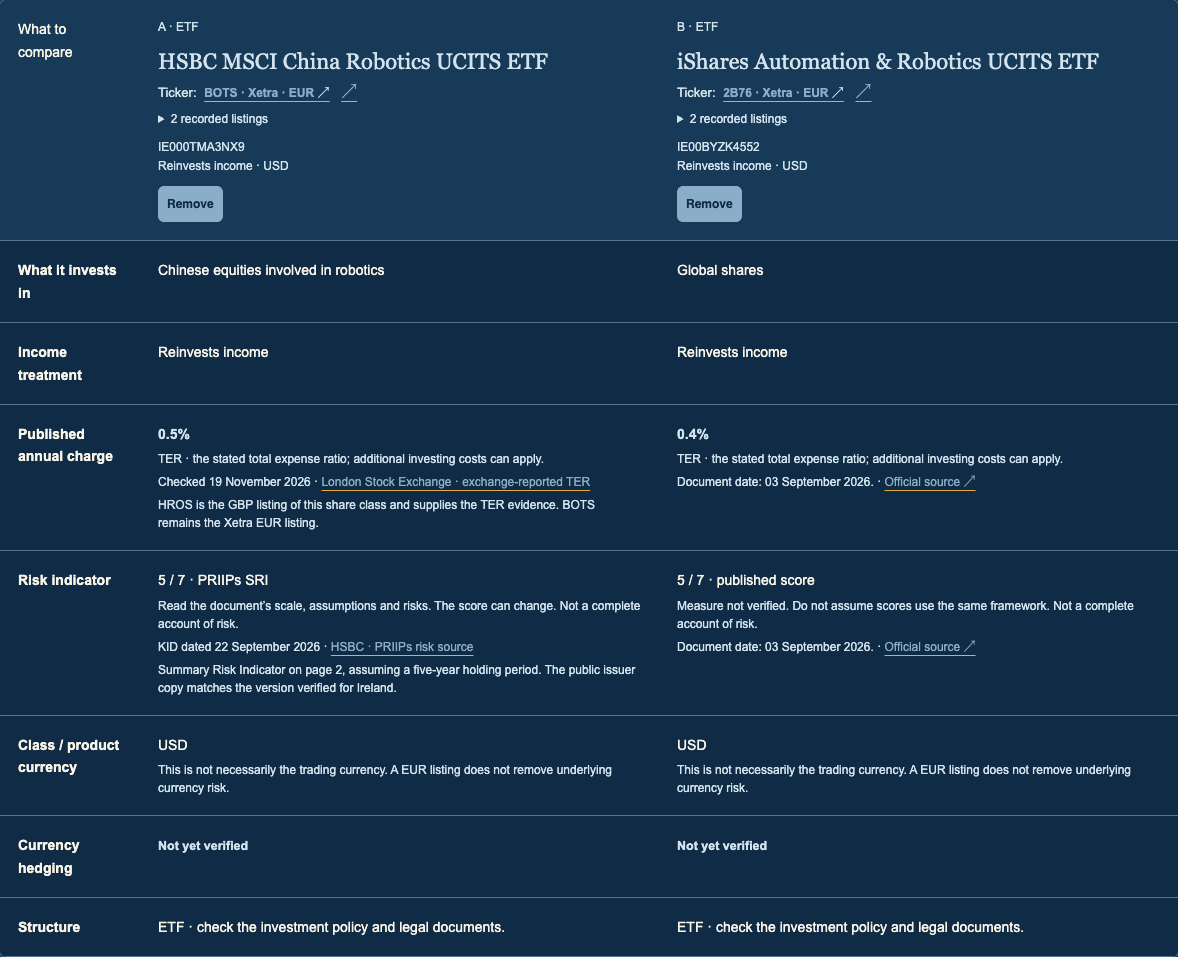
Finding the ETFs. For iShares, RBTX in London (GBP) and 2B76 on Xetra (EUR) share ISIN IE00BYZK4552. For HSBC, HROS in London (GBP) and BOTS on Xetra (EUR) share ISIN IE000TMA3NX9. Irish investors can search their broker by ISIN to see which trading lines it offers. iShares listings · HSBC London listing.
What is the case for holding both?
Adding HSBC gives an iShares investor a stake in more robotics suppliers. Take Leaderdrive. It makes the precision gears that control movement in a robot joint. At October month-end it was HSBC’s largest holding, at 6.22%, and iShares held none. An investor who already owned finished-robot maker FANUC through iShares could add a component maker through HSBC.
With €500 in BOTS and €500 in 2B76, €31.10 of the €1,000 would have been in Leaderdrive. It was one of eight companies in HSBC’s top ten that iShares did not hold. Together those eight accounted for €195.10, or 19.51% of the combined investment. HSBC’s smaller holdings could take that share above 19.51%.
The trade-off is greater exposure to China. In this example, half the money sits in a fund dedicated to Chinese businesses. You own more of the companies behind a robot, but their orders can still rise and fall together. A carmaker postponing a new production line can mean fewer orders for both the robot makers and the suppliers of their gears.