Portfolio X-Ray · Research
Choosing an AI ETF: six funds, different approaches.
Published · Holdings snapshot:
An AI ETF can invest in chipmakers, software developers, cybersecurity businesses or companies applying AI. Before choosing one, establish which version of the theme you want to own.
Artificial intelligence is changing how businesses operate. That does not make every company associated with AI an attractive investment, or every AI ETF the same investment proposition.
For an investor considering one AI ETF, the useful comparison starts with the exposure: what qualifies a company for inclusion, how much the fund allocates to it and which risks dominate the portfolio.
We examine six UCITS ETFs as alternatives. They are not a suggested portfolio of six funds.
The six funds form an illustrative editorial sample chosen to compare different approaches to AI investing. The sample is not an exhaustive survey of AI UCITS ETFs or a ranking by size, popularity or recent returns.
The six funds at a glance
Tickers shown are example EUR listings, with the exchange identified, checked on 3 November 2026. Tickers can differ by exchange; the ISIN identifies the selected share class. Trading in euros does not add a currency hedge. Ticker sources and listing details.
| ETF / selected share class | ISIN | Annual TER/OCF | Per €10,000* | Approach | Investment focus |
|---|---|---|---|---|---|
| WisdomTree Artificial Intelligence UCITS ETF — USD AccTicker: WTAI · Borsa Italiana · EUR | IE00BDVPNG13 | 0.40% | €40 | Index | AI enablers, engagers and enhancers |
| Xtrackers Artificial Intelligence & Big Data UCITS ETF 1CTicker: XAIX · Xetra · EUR | IE00BGV5VN51 | 0.35% | €35 | Index | AI, big data and cybersecurity |
| Amundi MSCI Robotics & AI UCITS ETF AccTicker: GOAI · Xetra · EUR | LU1861132840 | 0.40% | €40 | Index | Robotics, AI and wider automation |
| Invesco Artificial Intelligence Enablers UCITS ETF AccTicker: IVAI · Xetra · EUR | IE000LGWDNE5 | 0.35% | €35 | Index | Technology and services enabling AI |
| iShares AI Infrastructure UCITS ETF — USD AccTicker: AIFS · Xetra · EUR | IE000X59ZHE2 | 0.35% | €35 | Index | Infrastructure supporting AI |
| iShares AI Innovation Active UCITS ETF — USD AccTicker: IART · Xetra · EUR | IE000G0E83X3 | 0.73% | €73 | Active | Companies selected by an investment team |
*Approximate annual fund charge at a constant €10,000 value. Excludes fund transaction costs, spreads, brokerage, FX and platform charges. Fees are from issuer materials checked for this research; document dates vary. All selected classes accumulate income. Accumulation does not remove Irish tax obligations. Sources: issuer pages and documents linked below.
One theme, several ways to invest
WisdomTree (WTAI): an explicit AI classification
WisdomTree categorises companies as enablers, engagers or enhancers. Its September factsheet assigns these groups target weights of 50%, 40% and 10%, respectively, and scores companies partly on estimated AI revenue exposure and the importance of AI to their products. The distinction: not every constituent needs to earn most of its revenue from AI.
Xtrackers (XAIX): AI plus data and cybersecurity
Xtrackers uses a patent-based thematic approach spanning AI, big data and cybersecurity. Its September factsheet reports 90 index constituents. This captures a broader digital theme; the definition should be checked against an investor’s intended AI exposure.
Amundi (GOAI): broader than robots
Amundi’s benchmark includes cloud computing, cybersecurity, medical robotics, connected devices and vehicle automation. At 30 September, its benchmark’s largest positions included CrowdStrike, Palo Alto Networks and AMD. The word “robotics” should not be read as a promise that industrial robot manufacturers dominate the portfolio.
Invesco (IVAI): the businesses enabling AI
Invesco targets companies developing the technology, infrastructure and services supporting AI. Its selection spans hardware, software, infrastructure services and data management, with an additional weighting factor for businesses classified as core to the theme. At 30 September, disclosed holdings included Intel, Dell, Rackspace and DigitalOcean.
iShares Infrastructure (AIFS): a defined infrastructure index
This fund tracks the STOXX Global AI Infrastructure Index. Its September factsheet lists 52 holdings, including AMD, Intel, Palo Alto Networks and semiconductor equipment manufacturers. “Infrastructure” here extends beyond buildings and power networks.
iShares Active (IART): manager judgement
The active fund lets an investment team select AI-related businesses. Its September factsheet reports 48 holdings; Micron, AMD and Nvidia were its three largest. The investor accepts the team’s selection decisions alongside the thematic risks. A higher charge does not establish superior future returns.
How concentrated are the portfolios?
The top-ten share shows how much depends on a small group of positions. It does not measure every form of risk.
| ETF | Top ten weight | Snapshot | Evidence qualification |
|---|---|---|---|
| WisdomTree (WTAI) | 24.42% | 30 September 2026 | Calculated by summing ten disclosed fund weights |
| Xtrackers (XAIX) | 45.40% | 30 September 2026 | Calculated by summing ten disclosed fund weights |
| Amundi (GOAI) | 38.21% | 30 September 2026 | Benchmark holdings, not a separately verified fund-holdings figure |
| Invesco (IVAI) | 28.35% | 30 September 2026 | Calculated from ten disclosed fund weights in September factsheet |
| iShares Infrastructure (AIFS) | 41.32% | 30 September 2026 | Issuer-reported fund figure |
| iShares Active (IART) | 42.31% | 30 September 2026 | Issuer-reported fund figure |
WisdomTree spreads its largest positions more evenly in this snapshot. That does not establish it as the lowest-risk choice: many different companies can still respond to the same technology spending cycle, interest rates or valuation pressure.
Index weight limits also need interpretation. Xtrackers describes a 4.5% security cap, yet some September fund positions exceeded that level. A construction or rebalancing limit should not be presented as a continuously enforced portfolio maximum.
The top ten, fund by fund
These lists show the positions behind the labels. All six snapshots are dated 30 September 2026. Five lists are disclosed fund holdings; Amundi’s source reports benchmark constituents, which are identified separately.
Weights are percentages of each fund, or of the Amundi benchmark. Names are shortened for readability while share classes and ADR distinctions are retained where relevant. The totals sum the issuer’s rounded published weights.
WisdomTree Artificial Intelligence
| Rank | Holding | Weight |
|---|---|---|
| 1 | Advanced Micro Devices | 3.12% |
| 2 | NVIDIA | 2.48% |
| 3 | Alphabet — Class A | 2.43% |
| 4 | Tempus AI | 2.40% |
| 5 | Marvell Technology | 2.40% |
| 6 | NICE — sponsored ADR | 2.35% |
| 7 | Meta Platforms — Class A | 2.34% |
| 8 | Palantir Technologies — Class A | 2.32% |
| 9 | Amazon.com | 2.30% |
| 10 | Synopsys | 2.28% |
| Top-ten total | 24.42% | |
Largest position: 3.12% · Top three: 8.03%
AMD is the largest disclosed position at 3.12%. Tempus AI and NICE sit alongside Alphabet, Meta and Amazon. The ten positions account for less than a quarter of the fund in this snapshot; the remainder of the portfolio still needs to be considered before drawing conclusions about risk.
Source: Issuer September factsheet, page 3.
Xtrackers Artificial Intelligence & Big Data
| Rank | Holding | Weight |
|---|---|---|
| 1 | Microsoft | 5.75% |
| 2 | Meta Platforms — Class A | 5.35% |
| 3 | Apple | 4.93% |
| 4 | NVIDIA | 4.82% |
| 5 | Advanced Micro Devices | 4.41% |
| 6 | Amazon.com | 4.35% |
| 7 | Walmart | 4.04% |
| 8 | Alphabet — Class A | 4.04% |
| 9 | Samsung Electronics | 3.86% |
| 10 | Micron Technology | 3.85% |
| Top-ten total | 45.40% | |
Largest position: 5.75% · Top three: 16.03%
Microsoft, Meta and Apple together represent 16.03%. Walmart’s 4.04% position is a useful reminder that the patent-based selection extends beyond familiar AI suppliers. This is the most concentrated top-ten list in the selected snapshot, which does not on its own establish the highest overall risk.
Source: Issuer September factsheet, page 2.
Amundi MSCI Robotics & AI
| Rank | Holding | Weight |
|---|---|---|
| 1 | CrowdStrike Holdings — Class A | 5.04% |
| 2 | Palo Alto Networks | 4.90% |
| 3 | Advanced Micro Devices | 4.45% |
| 4 | Arista Networks | 4.21% |
| 5 | Microsoft | 3.61% |
| 6 | SAP | 3.50% |
| 7 | Apple | 3.34% |
| 8 | NVIDIA | 3.12% |
| 9 | Intel | 3.10% |
| 10 | Western Digital | 2.95% |
| Issuer-reported top-ten total | 38.21% | |
Amundi reports a 38.21% total. The ten rounded weights displayed above sum to 38.22%; the 0.01 percentage-point difference is retained rather than changing a disclosed position.
Largest position: 5.04% · Top three: 14.39%
CrowdStrike and Palo Alto Networks together make up 9.94% of the benchmark. AMD, Arista and Microsoft also feature prominently. These names show why the robotics label should not be interpreted as a portfolio dominated by industrial robot makers. The weights here describe the benchmark; they are not presented as separately verified fund positions.
Source: Issuer September factsheet, page 3.
Invesco Artificial Intelligence Enablers
| Rank | Holding | Weight |
|---|---|---|
| 1 | Intel | 3.21% |
| 2 | Dell Technologies — Class C | 3.04% |
| 3 | Everpure — Class A | 2.93% |
| 4 | DigitalOcean Holdings | 2.87% |
| 5 | Rackspace Technology | 2.82% |
| 6 | Super Micro Computer | 2.77% |
| 7 | Lumentum Holdings | 2.72% |
| 8 | NetApp | 2.68% |
| 9 | Seagate Technology Holdings | 2.67% |
| 10 | NICE — ordinary shares | 2.64% |
| Top-ten total | 28.35% | |
Largest position: 3.21% · Top three: 9.18%
Intel, Dell and Everpure together account for 9.18%. The list is markedly different from the large platform-company mix in Xtrackers. NVIDIA does not appear in these ten disclosed positions; that is not evidence of zero exposure elsewhere in the fund. Everpure is reproduced under the issuer’s factsheet label.
Source: Issuer September factsheet, page 2.
iShares AI Infrastructure
| Rank | Holding | Weight |
|---|---|---|
| 1 | Advanced Micro Devices | 4.52% |
| 2 | Intel | 4.46% |
| 3 | Palo Alto Networks | 4.37% |
| 4 | Palantir Technologies — Class A | 4.19% |
| 5 | Applied Materials | 4.19% |
| 6 | Micron Technology | 4.05% |
| 7 | ASML Holding | 3.94% |
| 8 | NVIDIA | 3.89% |
| 9 | Microsoft | 3.88% |
| 10 | KLA | 3.83% |
| Top-ten total | 41.32% | |
Largest position: 4.52% · Top three: 13.35%
AMD, Intel and Palo Alto Networks together represent 13.35%. Applied Materials, ASML and KLA add another 11.96% between them. The disclosed names make the breadth of “infrastructure” tangible: this is not simply a fund of data-centre buildings or power suppliers.
Source: Issuer September factsheet, page 3.
iShares AI Innovation Active
| Rank | Holding | Weight |
|---|---|---|
| 1 | Micron Technology | 6.47% |
| 2 | Advanced Micro Devices | 5.42% |
| 3 | NVIDIA | 5.26% |
| 4 | Taiwan Semiconductor Manufacturing | 4.68% |
| 5 | Broadcom | 4.28% |
| 6 | Lam Research | 4.19% |
| 7 | Intel | 3.21% |
| 8 | Space Exploration Technologies | 3.09% |
| 9 | Snowflake | 2.90% |
| 10 | Lumentum Holdings | 2.81% |
| Top-ten total | 42.31% | |
Largest position: 6.47% · Top three: 17.15%
Micron, AMD and NVIDIA together represent 17.15%. The manager also holds Space Exploration Technologies at 3.09%, Snowflake at 2.90% and Lumentum at 2.81%. The Space Exploration Technologies name is taken from the factsheet; this table does not establish the security’s listing status or liquidity terms.
Source: Issuer September factsheet, page 3.
What the lists reveal
There are familiar names, but very different weights. AMD and NVIDIA appear in five of the six disclosed lists, including Amundi’s benchmark list. That does not make the portfolios interchangeable.
Share classes need care. WisdomTree’s list identifies a NICE ADR, while Invesco identifies NICE ordinary shares. Those are different security lines linked to the same company; a company-level overlap study would need to map them consistently.
A missing name is not a zero. These are ten-position disclosures, not complete portfolios. They cannot establish full overlap, total semiconductor exposure or the share of revenue attributable to AI.
What does one AI ETF add to a global portfolio?
A global equity ETF already provides exposure to several prominent AI-related businesses. Vanguard’s FTSE All-World ETF held Nvidia, Microsoft, Alphabet, Amazon, TSMC and Broadcom at 30 September 2026.
An AI ETF does not necessarily increase exposure to every familiar AI company. Nvidia represented approximately 5.01% of that global fund, compared with 2.48% of WisdomTree and 3.89% of iShares Infrastructure on the same date. Replacing some of the global fund with either of those AI funds would, in isolation, reduce the combined Nvidia weight while changing other exposures.
For illustration: 90% in the global ETF and 10% in WisdomTree would give approximately 4.75% Nvidia exposure, using those snapshot weights. This is arithmetic, not a suggested allocation.
The relevant question is what the entire AI allocation changes: company weights, semiconductor dependence, geography and valuation sensitivity. Common holdings alone do not establish identical portfolios. A complete weighted overlap calculation has not been performed for this research.
See the comparison on Rogha
Rogha’s Explore & Compare tool brings together the investment description, income treatment, published charge and available risk information for an exact share class.
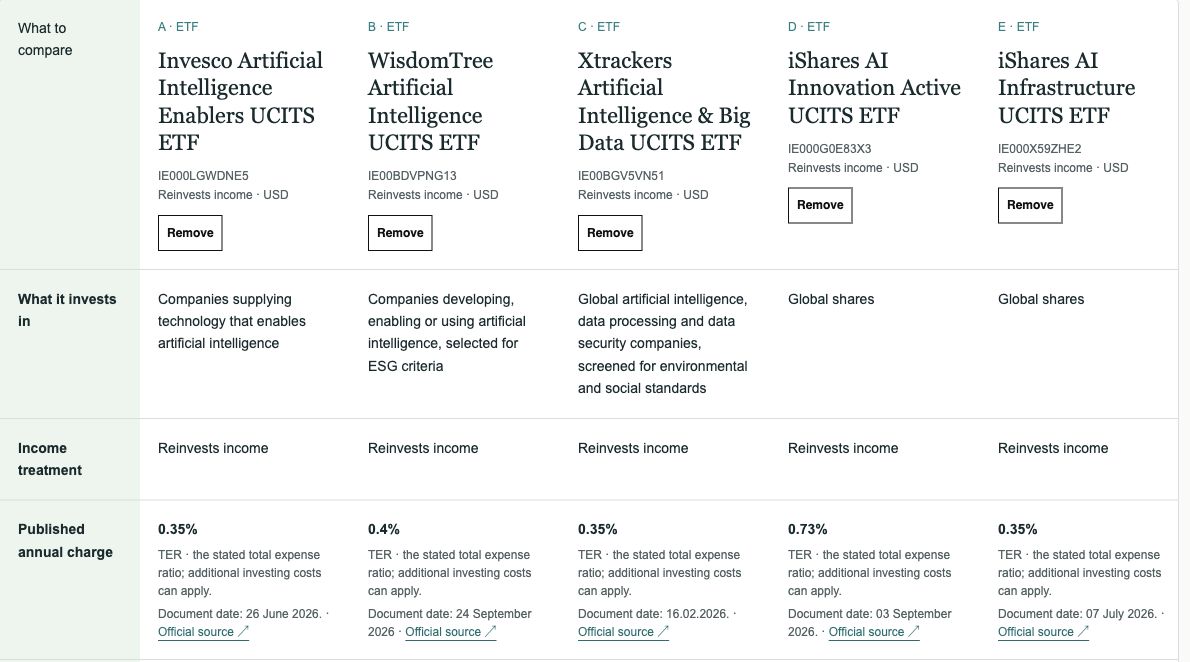
Explore and compare ETFs on Rogha →
Coming soon: Portfolio X-Ray is intended to help investors examine how an ETF fits alongside existing investments, including overlapping holdings and concentration.
Choose the exposure before choosing the fund
A useful decision sequence is to define the AI exposure you want, examine how the fund constructs it, check the largest risks, and then compare costs.
At €10,000, the difference between a 0.35% and 0.73% annual fund charge is approximately €38 a year before changes in value. Portfolio differences can have a much larger effect on outcomes. The cheapest ETF and the most suitable exposure are separate questions.
AI adoption can grow while AI-related shares fall. Strong business growth may already be reflected in prices, competition can compress margins and technological change can undermine today’s leaders. These are concentrated equity exposures and do not replace a broadly diversified portfolio.
Irish investors should confirm the exact ISIN, broker availability, current KID and tax treatment. Inclusion here does not establish IIA eligibility or universal Irish retail access.
Conclusion: is an AI ETF worth adding to a global equity ETF?
For an investor seeking broad, simple equity exposure, there is no clear need to add an AI ETF. A global equity ETF already provides exposure to major AI-related businesses. In our September snapshot, the global reference held Nvidia, Microsoft, Alphabet, Amazon, TSMC and Broadcom.
An AI ETF can be worth considering if you deliberately want a different mix: more weight in AI enablers, infrastructure suppliers or companies selected by an active manager. The reason to add it should be a clear view of what those holdings contribute alongside the global fund.
That choice comes with trade-offs. Thematic funds can concentrate exposure to particular technologies and business models. The selected AI funds also charge more than our global reference. Adding more company names does not automatically spread the underlying risks. Nor does a smaller Nvidia position establish that the combined portfolio is safer. The whole allocation matters, including what you reduce to fund it.
Our comparison shows that these six approaches produce different portfolios. It has not established that adding any of them improves a global portfolio’s diversification or future returns. An AI ETF is therefore an optional thematic allocation for someone who wants that specific exposure and can accept losses or prolonged underperformance. A global equity investor can participate in AI without adding one.
Rogha ETF — Understand ETFs. Don’t just choose them.
Methodology matters more than the label
The STOXX infrastructure selection uses patent and sector-revenue evidence. Its classification includes pure players, innovators and market leaders. The pure-player threshold should not be described as applying to every company in the ETF, and relevant sector revenue is not necessarily separately disclosed AI revenue.
WisdomTree explicitly combines businesses for which AI is central with companies for which the relevant AI product is not yet a core revenue source. Xtrackers’ patent-based selection is also broader than a simple screen for companies reporting most revenue from AI. A comparable, independently verified percentage of each fund’s revenue attributable to AI has not been established.
What changes alongside a global ETF?
| Holding | Global equity reference | WisdomTree | Xtrackers | iShares Infrastructure | iShares Active |
|---|---|---|---|---|---|
| Nvidia | 5.01% | 2.48% | 4.82% | 3.89% | 5.26% |
| Microsoft | 3.58% | Not in disclosed top ten | 5.75% | 3.88% | Not in disclosed top ten |
Snapshot: 30 September 2026. Global equity reference: Vanguard FTSE All-World UCITS ETF, IE00BK5BQT80. “Not in disclosed top ten” does not mean zero exposure. These examples demonstrate changes in individual company weights; they are not a full overlap calculation.
For a new investor, this is a better explanation than suggesting they need several AI ETFs: choose the version of AI exposure intended, and understand how that single choice changes the existing portfolio.
Additional sources
Sources
Issuer factsheets use 30 September 2026 unless noted; Product pages may carry later fee updates. Figures are not a live price feed.
Continue your research
Read our Learn guides on core and specialist ETFs, ETF overlap, fund charges and total cost and risk and volatility.
Comments or corrections? Email hello@roghaetf.ie.