Irish investing · Research
ETF distribution in Ireland: start with the customer
Published · Updated
Ireland’s success as a home for ETFs and the experience of an Irish person buying one are different achievements. For someone investing €200 a month, a competitive fund charge is only part of the calculation. The cost of advice, dealing and administration - and the help available when something goes wrong - can determine whether the investment is practical to own.
Broad-market ETFs can spread a modest investment across many companies or bonds through a single purchase. By making diversified market exposure accessible without the capital or work needed to buy each security individually, they can help democratise investing - provided the cost and service around them work for smaller investors. The Central Bank on retail access.
The proposed Irish Investment Account gives this question new urgency. Revenue announced preparations for a July 2027 opening, subject to legislation. The industry now has an opportunity to show how affordable investing can work throughout the customer’s life, from the first decision to the eventual withdrawal. Revenue’s announcement.
Historically, institutions accounted for most recorded ETF holdings by Irish residents. The value of households’ recorded holdings rose from €329 million at end-2015 to €703 million in the third quarter of 2019. These are domestic ownership figures, distinct from the worldwide investor base of Irish-domiciled ETFs. Central Bank research, January 2020.
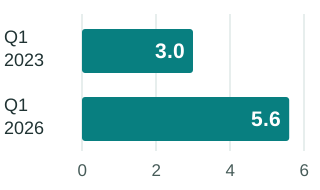
The Central Bank’s expanded statistics put direct household ETF holdings at €5.6 billion at end-Q1 2026, compared with €3 billion in Q1 2023. Central Bank analysis, August 2026.
Across household securities holdings as a whole, the Central Bank found that rising securities prices drove most of the growth in 2025, rather than an increase in transaction volumes. Central Bank analysis, August 2026.
Direct Irish household ETF holdings
Market value, € billions
What the new Investment Account changes
The proposed Irish Investment Account (IIA) would allow Irish tax-resident adults with a PPSN to contribute up to €12,000 a year, with no minimum contribution. The announced design permits one account per person and a range of investments, including eligible ETFs, shares, bonds and insurance-based products. Product availability would depend on the provider. CCPC overview.
The €12,000 is one contribution allowance across those investments. Someone putting €6,000 into ETFs and €3,000 each into eligible shares and bonds would use the full allowance.
For service design, the limit matters. €12,000 a year is equivalent to €1,000 a month over a full year. Our €200-a-month customer would contribute €2,400. Providers should test costs for smaller payments and mixed portfolios, rather than assume every customer contributes the maximum entirely to ETFs.
The proposed tax has a different base: 1% a year on the account’s average daily value above €50,000. The threshold concerns account value, not annual contributions or profit. At an average value of €60,000, the account tax would be €100, even if the investments lost value that year. Finance Bill, proposed section 747Q.
Under the announced framework, the usual Irish investment tax regimes, including deemed disposal, would not apply to eligible investments inside the account. Providers would handle account tax reporting and payment. This could reduce administration for customers, but fees and investment risk still matter. The planned provider launch is 1 July 2027, subject to legislation and implementation. Department of Finance, Budget 2027.
The customer journey does not start with the ticker
Consider someone who can put €200 a month aside and wants to invest for the longer term. They may have heard that ETFs offer a way to spread their money across many investments. Their questions are likely to be more basic: how much can I afford to put at risk, what should I understand before I begin, who can help me, and what happens after I buy?
The industry has historically presented the decision from the opposite direction. There is a fund, a benchmark, a factsheet, a charge and an exchange listing. Each is useful information. Together they can still leave the customer unsure whether the investment addresses their purpose.
Starting with the customer means making room for circumstances before presenting products. Money needed soon, emergency savings and a long-term investment do different jobs. Some people need personalised advice. Others are comfortable making their own decisions but need reliable information and an efficient way to act. Some should defer investing. A distribution journey should be able to accommodate all three outcomes.
Customer research gives these questions substance. In the Central Bank’s survey, 64% of non-investors cited fear of losing money, 59% insufficient spare money and 48% lack of knowledge. Respondents could select several reasons; these findings cover investing generally. Better explanations address one barrier, but cannot create spare income or make investment risk suitable for everyone. CBI consumer research, pp. 24–26.
The intermediary’s economics shape the route
Many customers approach investing through an existing relationship with a financial broker, adviser, bank or insurer. What that relationship can offer depends on the firm’s permissions, product access, systems and expertise. It also depends on how the work is paid for.
The Central Bank’s retail participation research raises concerns about access to independent advice for people with smaller amounts to invest. It describes a distribution model in which intermediary remuneration can steer the market towards insurance-based investment products. Its supervisory outlook separately highlights the conflicts that can arise from commission arrangements. Retail participation research; supervisory outlook.
These findings deserve attention. Advice has a cost. Understanding a customer’s circumstances, researching investments, explaining risks and maintaining records take time. A smaller account does not necessarily require proportionately less work than a larger one.
A direct ETF purchase may not fit an intermediary’s established route for recovering those costs. A modest account may not support extensive personal advice and continuing assistance at a price the customer will accept. The firm needs to define the service, identify who pays and demonstrate its value. Transparent pricing helps customers judge the proposition; it does not, by itself, make the service affordable.
An insurance or pension arrangement can provide features beyond its underlying investments. Comparing its full charge with an ETF’s fund charge alone is unfair. An advised or delegated service may suit a customer better despite a higher visible charge. The decision needs to reflect the complete service, tax treatment, access to the money and total cost.
Knowledge matters, but so does the ability to act
The evidence reviewed does not establish that Irish advisers generally lack ETF knowledge. The June 2026 consolidated minimum competency code includes ETFs within savings and investments. Qualifications, however, do not establish every firm’s practical experience or dealing capability. Current consolidated code, printed p. 46.
Helping a customer use an ETF involves share classes, exchange listings, currency exposure, execution, custody and records. A knowledgeable firm could lack a suitable dealing route, while a firm with platform access could find small recurring investments uneconomic to support.
Training, infrastructure and remuneration address different constraints. Treating them all as a question of adviser willingness would miss much of the work required.
Access exists. What experience does it deliver?
Irish retail customers already have ways to buy ETFs. Domestic execution-only services and cross-border platforms offer different propositions. Davy Select distinguishes execution-only investing from its advised services; DEGIRO publishes an Irish ETF dealing schedule. Davy Select; DEGIRO Ireland.
An order screen can still present several listings for the same fund, apparently similar products and unfamiliar currency choices. A confident investor placing occasional larger orders may value a different service from someone starting a monthly investment. Customers need to know what each service provides, what it costs and what remains their responsibility.
Make the important differences understandable
Good product information should answer the questions most likely to change the customer’s decision. What does the fund own? How concentrated is it? What is its objective? What risks does it introduce? How is its return affected by costs and currencies?
Our recent portfolio-overlap study illustrates the value of that approach. A customer can add an S&P 500 ETF to a developed-world fund and increase the weight in companies already held. The second fund changes the portfolio, but its name alone does not explain how. A comparison of the underlying exposures is more useful than counting the number of funds in the account.
The same applies to currency. A euro trading price does not establish that the investment is currency hedged. Active management, income distributions and option strategies also require explanations that go beyond the label on the fund.
A clear explanation can lead to a comparison and then the formal documents. Customers need to find the information and understand its significance. Delivering a document does not demonstrate comprehension.
Small investments need a different cost conversation
A low fund charge can coexist with a relatively expensive investing routine. For a customer making small purchases, a fixed dealing charge can be material even when the amount looks modest in euros.
For our customer investing €200 a month, a hypothetical €3 dealing charge would absorb 1.5% of each contribution before other costs.
Account charges, subscriptions, currency conversion, spreads and transfer costs can also affect the experience. Customers need these costs explained alongside the fund’s own charges. A service described as commission-free may still involve other costs.
The provider needs sustainable revenue. If it earns more when customers trade frequently, that incentive deserves scrutiny alongside any message encouraging long-term ownership.
Show the customer’s intended pattern of use in euros, with assumptions and the services received. Advice, custody, execution and administration involve different work and responsibilities.
Execution-only still needs support
In an execution-only service, the customer chooses the investments. Clear explanations and helpful support do not amount to an assessment that those choices suit the customer’s circumstances. Assistance can include information about product features, help navigating an account and support when something goes wrong.
A personalised selection, allocation or recommendation presented as suitable for someone can be different from a factual comparison. The substance of the interaction matters; calling it educational does not decide whether it is advice. ESMA advice guidance.
Someone seeking reassurance about which investment is right for them needs to know whether the service can provide it, and where to obtain advice if it cannot. Execution-only suits some customers; others need a personal recommendation. Regulatory protections and assessments also depend on the instrument and service. The ETF label is not a universal shortcut.
The relationship continues after purchase
For a long-term investor, buying may be the shortest part of ownership. The customer will live with distributions, changes in value, statements, tax records and occasional changes to the fund for much longer than they spend placing the initial order.
That makes administration part of the investment proposition. Customers need records they can understand and retain, including purchases, sales, distributions, charges and relevant currency information. In Ireland, the tax treatment depends on the investment’s characteristics and applicable fund regime. A familiar exchange listing is not enough to determine it. Revenue’s ETF guidance.
Outside the proposed IIA, ETF holdings within the relevant fund-tax rules can trigger tax after eight years even if nothing has been sold. Regular purchases can create separate anniversary dates to track. Useful records matter throughout ownership, but do not remove the underlying obligations. Providers should explain what their reports cover and where further help is needed. Revenue guidance, Part 27.
The IIA would change the account’s tax administration, not the risks of the investments within it. A customer would still need to choose an appropriate investment and understand the provider’s costs and support. Improving distribution also means helping people judge whether another route, or deferring investment, better suits their needs.
The same standard should apply when a fund changes its objective, merges or closes. An investor should be told what is happening, what choices they have and whether any action is required. Communications during market falls should explain the investment and available services without turning uncertainty into a reason to trade.
Leaving should also be understandable. Transfer processes, costs and any restrictions matter to a customer’s control over their investment. For fractional arrangements, the nature of the ownership and ability to transfer need explanation rather than assumption.
Measure whether the customer is better served
The Central Bank’s Consumer Protection Code 2025 took effect on 24 March 2026. Its customer-interest focus is relevant to service design, while particular requirements depend on the firm and activity. Consumer Protection Code.
Account openings, assets and trading activity cannot establish whether customers are well served. Nor does a long holding period demonstrate understanding. Firms should examine comprehension, costs for actual patterns of use, execution, operational errors, complaints, support and transfers. Responsibility needs to remain clear when several firms deliver the service.
Conclusion
Ireland’s opportunity is to bring its investment expertise closer to the needs of its households. That requires practical changes to how products are explained, how services are paid for and how customers are supported. The following would be a useful starting point.
Make smaller accounts worth serving. Intermediaries and platforms should define a service they can afford to provide to someone investing €200 a month, and show what that customer would pay. Shared dealing and administration may reduce costs, but any savings need to be demonstrated. Where personal advice carries a separate charge, explain its scope and value before the customer commits. Train staff in the practical work of arranging and administering investments.
Provide clear routes to advice and execution. Customers should know which service they receive, who is responsible and what help it includes. Those needing a personal recommendation need a credible route to advice. Those choosing for themselves need dependable execution and operational support, with clear boundaries around any guidance.
Design for regular investing and long-term ownership. Show costs for the customer’s contribution pattern before they commit. Explain recurring orders, currency conversion and fractional ownership. For the IIA, track the shared contribution allowance and explain account tax. Support records for investments held outside it, communicate fund changes clearly and make transfers understandable.
Build investor education into the experience. Explain diversification, risk, costs, currencies and income versus total return. Use practical examples: what a fall in value means for money the customer may need, how charges affect a small contribution, and where to seek help. Check understanding without treating a decision to invest as the desired answer. Education should continue throughout ownership and help customers recognise when they need advice.
Test the result with customers. Ask people to explain what they own, what they pay and where they would go for help. Measure execution quality, errors, complaints and the ease of leaving alongside account growth. Use those findings to improve the service. A journey that produces more purchases but leaves customers confused has failed an important test.
Make comparisons usable. Issuers and distributors should present the features that change a customer’s decision in a consistent, understandable format: investment scope, concentration, currency policy, strategy and costs. Customers should be able to see what an ETF adds to an existing portfolio, with access to the underlying evidence. Product visibility and comparison rankings should not obscure commercial relationships.
These changes require commercially sustainable businesses. Advice, execution and support all need to be funded, and customers deserve to understand how. The industry’s task is to make that funding compatible with the investment behaviour it encourages, including small contributions and long holding periods.
The IIA creates an opportunity to improve the experience around investing as well as its tax administration. The test is whether the customer can afford the service, understand the investment and manage it throughout ownership.
Read or keep the full research paper
The 11-page PDF includes the article, methodology appendix and source links.
Explore further
Read our Learn guides on investment risk, currency exposure and what an ETF tracks. Our platform directory explains practical checks before opening an account.
What do you think?
We welcome comments, questions and corrections. Email hello@roghaetf.ie.